◢ DISPATCH / MISE
Setting Up a Machine with mise bootstrap
Posted on September 12, 2026·Updated on September 12, 2026·12 MIN READ·0 VIEWS
◢ This post is also available in: 日本語
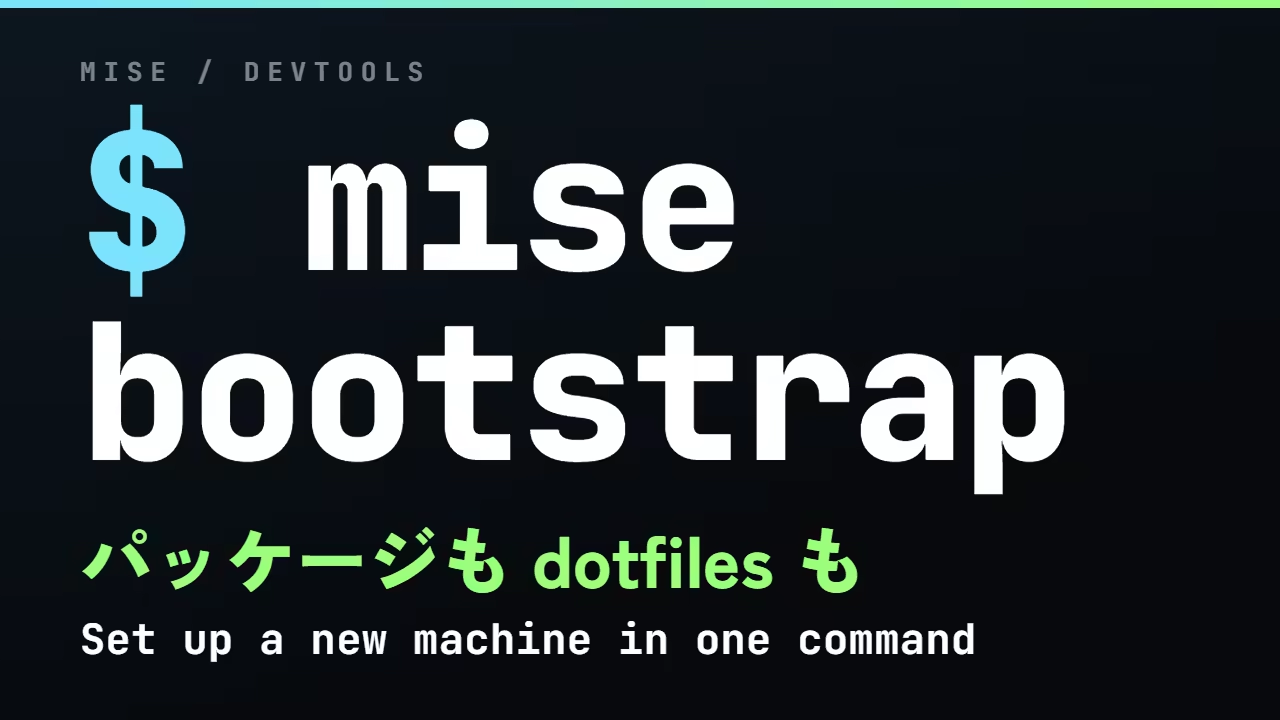
What mise bootstrap is
mise bootstrap is a way to declare how a machine is set up in a config file, and bring the
machine up to that state with one command. OS packages, dotfiles, shell activation, development
tools and a finishing task at the end: one config.toml covers all of it.
Getting started with mise put it this way for tool versions:
the setting belongs to the directory, not to the person who typed it. bootstrap takes that idea and
applies it to the whole machine. A project with a mise.toml is brought up to date by
mise install; a machine with a config is brought up to date by mise bootstrap.
What used to go wrong
Every new machine went the same way.
- Work out what to install from the package manager by remembering the last machine and reading
its
history - Clone the dotfiles repository and run the script that links them into place
- Add
mise activateto the shell configuration - And only then
mise install
The steps are written down somewhere. But the notes do not know about anything added since the last setup, and the gaps only show up when something stops working.
Ansible or Nix would solve this, but bringing either in for two or three personal machines always felt like too much. If mise is already there, writing it down in mise is the lightest option.
The smallest config
It does not go in a project's mise.toml but in the user's config file: a machine's setup
belongs to the person, not to a project, so it lives at ~/.config/mise/config.toml.
~/.config/mise/config.tomltoml
[bootstrap.packages]
"winget:BurntSushi.ripgrep.MSVC" = { os = "windows" }
"winget:Git.Git" = { os = "windows" }

[tools]
node = "22"

[tasks.bootstrap]
run = "node --version"
Three sections.
[bootstrap.packages]— what the OS package manager installs. Written asmanager:package, withosto narrow it down[tools]— the usual mise tools. Nothing changes here[tasks.bootstrap]— a task that runs after everything else. For checking the result, or for finishing touches that cannot be declared
As with any config that carries [env], the first run wants mise trust.
Seeing what will happen before it happens
There is no need to just run it. Three ways to look first.
--dry-run
Shows everything in the order it would run, without running it.
terminal
❯ mise bootstrap --dry-run
mise bootstrap: system packages
mise winget: 1 package(s) already installed
winget install --id BurntSushi.ripgrep.MSVC --exact --silent --accept-source-agreements --accept-package-agreements --disable-interactivity
mise bootstrap: tools
mise all tools are installed
mise bootstrap: running `bootstrap` task
[bootstrap] $ node --version
1 commands8 lines
Git is judged to be present and only ripgrep is up for winget install. The exact command that
would be run is printed, so flags like --silent and --accept-* are there to be checked.
plan
Tabulates how each declared resource would change from its current state.
terminal
❯ mise bootstrap plan
create     package:winget:BurntSushi.ripgrep.MSVC     missing               installed (any version)
unchanged  package:winget:Git.Git                     installed (2.55.0.3)  installed (any version)
Plan: 1 create, 0 update, 1 unchanged, 0 remove, 0 unknown
1 commands4 lines
It reads the way plan does in OpenTofu or Terraform: operation,
resource, current state, desired state, and a tally at the end.
status
What things look like right now.
terminal
❯ mise bootstrap status
packages  winget:BurntSushi.ripgrep.MSVC            missing
packages  winget:Git.Git                  2.55.0.3  installed
tools     node@22                         22.23.2   installed
1 commands4 lines
Running it
bash
mise bootstrapThe ripgrep on this machine came from somewhere other than winget, so for this article the packages section was skipped; how to skip is in the next section.
terminal
❯ mise bootstrap --skip packages
mise bootstrap: dotfiles
mise files: all files are applied
mise bootstrap: tools
mise ⇢ node@22  71ms · already installed
mise all tools are installed
mise bootstrap: running `bootstrap` task
[bootstrap] $ node --version
v22.23.2
1 commands9 lines
Run the same command again and everything that is already in place simply flows past. Resources that have not changed are skipped.
Each run records the state before and after it as checkpoints.
terminal
❯ mise bootstrap dotfiles history
12  2026-09-12 16:52  bootstrap           bootstrap
11  2026-09-12 16:52  bootstrap-before    before bootstrap
10  2026-09-12 16:52  bootstrap           bootstrap
9   2026-09-12 16:52  bootstrap-before    before bootstrap
8   2026-09-12 16:51  bootstrap (failed)  bootstrap
7   2026-09-12 16:51  bootstrap-before    before bootstrap
1 commands7 lines
A failed run stays in the list as (failed). This list comes back in the dotfiles section.
The order is fixed
mise bootstrap works through the declared sections in a set order. Roughly: foundations
first, and whatever is depended on before whatever depends on it.
- Linux users and groups, package-manager plugins
- Packages (
[bootstrap.packages]) and the files that go before and after them - Services, the firewall, Docker Compose projects
- Git repositories, dotfiles
- Shell activation, macOS defaults and LaunchAgents, Linux user units, user settings
- The tools in
[tools] - Packages from package-manager plugins, services that need tools
[tasks.bootstrap], then the final hook
Packages come before dotfiles, and [tasks.bootstrap] is last. The reading is that the editor
and shell the dotfiles assume are already installed, and by the time the finishing task runs,
everything declared is there to be used.
To run only part of it there are --only and --skip. Both can be repeated; they cannot be
combined.
bash
mise bootstrap --skip packages    # everything except packages
mise bootstrap --only tools       # tools only
The names are the section names above — packages, dotfiles, shell, tools, task and so
on. Get one wrong and the error lists every valid one.
Packages
Written as manager:package. The manager cannot be left out: the same ripgrep has a different name
in apt, brew and winget.
~/.config/mise/config.tomltoml
[bootstrap.packages]
"apt:ripgrep" = { os = "linux" }
"brew:ripgrep" = { os = "macos" }
"winget:BurntSushi.ripgrep.MSVC" = { os = "windows" }
"brew-cask:font-jetbrains-mono" = { os = ["linux", "macos"] }
"pacman:libreoffice-fresh" = { state = "absent" }
Narrowing with os lets one config file serve machines running different systems.
state = "absent" means "remove it if it is there".
The supported managers are apt / apk / dnf / pacman / aur / brew / brew-cask / flatpak / nix / mas
/ winget. On Windows, winget is used whenever it is on PATH.
One behaviour worth knowing: "latest" means "present is good enough". A package that is
already installed is not upgraded to the newest version on every run. To upgrade, run
mise bootstrap packages upgrade explicitly. A command whose job is to bring the machine to a
declared state should not start updating things on its own, and I think that is the right design.
dotfiles
This is the most interesting part. Beyond linking dotfiles into place, it keeps a history of their changes.
First, put an existing file under tracking.
terminal
❯ mise bootstrap dotfiles track ~/.bashrc
mise history: saved baseline checkpoint 1
mise dotfiles: tracking ~/.bashrc (declared in ~/.config/mise/config.toml)
mise WARN  history: automatic capture is inactive: declare `[bootstrap.services.mise-history] builtin = "history-watch"` and run `mise bootstrap`; until then edits are saved by `mise bootstrap dotfiles save` or `mise bootstrap dotfiles watch --once`
1 commands4 lines
The file is left as it is, its current contents are saved as checkpoint 1, and this is added to the config.
~/.config/mise/config.tomltoml
[dotfiles]
"~/.bashrc" = { mode = "track" }
Edit the file and save.
terminal
❯ echo 'alias gs="git status"' >> ~/.bashrc
❯ mise bootstrap dotfiles save ~/.bashrc
mise history: saved checkpoint 2: edited ~/.bashrc
2 commands3 lines
The history and the diff are there to read.
terminal
❯ mise bootstrap dotfiles history --path ~/.bashrc
2  2026-09-12 16:50  save      edited ~/.bashrc
1  2026-09-12 16:50  baseline  tracked ~/.bashrc
1 commands3 lines
terminal
❯ mise bootstrap dotfiles history diff 2 --path ~/.bashrc --patch1 commands1 lines
diff
@@ -1,2 +1,3 @@
 export EDITOR=vim
 alias ll="ls -la"
+alias gs="git status"
And it can be undone.
terminal
❯ mise bootstrap dotfiles rollback ~/.bashrc
mise history: rolled back ~/.bashrc to checkpoint 1
1 commands2 lines
rollback picks the newest saved version whose contents differ from the file as it is now. When
a config file has been fiddled into a broken state, it feels like having git stash for it.
The track output carried a WARN saying automatic capture is inactive. It means that by
default no checkpoint is taken unless save is run after each edit. As the same WARN says,
declaring a service that picks up changes on its own removes that chore.
~/.config/mise/config.tomltoml
[bootstrap.services.mise-history]
builtin = "history-watch"
It registers as a systemd user service on Linux, a LaunchAgent on macOS, and a Task Scheduler task on Windows.
Links, copies and templates
The other side: not tracking, but putting dotfiles from a repository into place.
~/.config/mise/config.tomltoml
[settings]
dotfiles.root = "~/.dotfiles"

[dotfiles]
"~/.config/nvim" = { source = "nvim", mode = "symlink" }
"~/.gitconfig" = { source = "gitconfig.tera", mode = "template" }
"~/.zshrc/activate" = { block = 'eval "$(mise activate zsh)"' }symlink(the default) — a link. Editing the target edits the repository copycopy— a copy. Editing the target directly is overwritten on the next runtemplate— renders a template and writes the result. Per-machine values go in as{{ vars.email }}block/line— manages just one marker-fenced section, or one line, inside an existing file
Leave out source and the file is looked for under dotfiles.root at the same relative path as
its target: ~/.zshrc comes from ~/.dotfiles/.zshrc.
On Windows, symbolic links need Developer Mode. Without it, mise falls back to copying, and directory links become junctions.
Shell activation
Adding the mise activate line to the shell's config file can be declared too.
~/.config/mise/config.tomltoml
[bootstrap.mise_shell_activate]
zprofile = "shims"
zshrc = "activate"
bashrc = "activate"
fish = "activate"
Only a marker-fenced block is written.
bash
# >>> mise:activate >>>
eval "$(mise activate zsh)"
# <<< mise:activate <<<
mise rewrites that range and nothing else, so the other lines are left alone.
The second machine
With the config so far in a Git repository, the next machine is two lines. From here on, a fresh Debian container stood in for the second machine.
bash
curl https://mise.run | sh
mise bootstrap --adopt you/setup --yes
What --adopt does, --dry-run says in one line.
text
Would run: git clone /setup ~/.config/miseThe repository itself becomes ~/.config/mise. So the repository is shaped like the config
directory.
text
setup/
  config.toml
  dotfiles/
gitconfigconfig.tomltoml
[bootstrap.packages]
"apt:ripgrep" = { os = "linux" }

[bootstrap.mise_shell_activate]
bashrc = "activate"

[dotfiles]
"~/.gitconfig" = { source = "dotfiles/gitconfig", mode = "copy" }

[tools]
node = "22"

[tasks.bootstrap]
run = ["rg --version | head -1", "node --version"]
Run it, and it flows from the top.
text
Cloning into '/root/.config/mise'...
mise bootstrap: system packages
mise $ apt-get install -y -- ripgrep
mise apt: installed ripgrep
mise bootstrap: dotfiles
mise files: copied ~/.config/mise/dotfiles/gitconfig to ~/.gitconfig
mise bootstrap: shell activation
mise edits: applied ~/.bashrc (block:activate)
mise bootstrap: tools
mise ✓ node@22.23.2  48.7s  node-v22.23.2-linux-x64.tar.gz
mise bootstrap: running `bootstrap` task
[bootstrap] $ rg --version | head -1
ripgrep 14.1.1
[bootstrap] $ node --version
v22.23.2Running it over SSH from here
If the machine is reachable over SSH, nothing has to be typed on it at all.
bash
mise bootstrap remote --host devbox --adopt ~/src/setup --install-mise --yesmise does not need to be installed there. Your own mise is sent over, unpacked into /tmp on
the target and run. Given a local path, --adopt ships the repository along as a git bundle, so
the target does not need to reach the repository either.
text
mise bootstrap remote root@172.17.0.4 (root@172.17.0.4)
2026.9.5 linux-x64 (2026-09-10)
mise bootstrap: system packages
mise apt: installed ripgrep
...
mise remote bootstrap completed on 1 target(s)
Both flags are there for a reason, each one learned the hard way.
--install-mise— without it, the mise that was sent over is removed when the run ends. But theeval "$(mise activate bash)"that[bootstrap.mise_shell_activate]wrote into.bashrcstays, so from the next shell onward every prompt starts withmise: command not found. With it, mise stays at~/.local/bin/mise(putting~/.local/binonPATHis yours to do, just as aftercurl | sh)--adopt— there is also--source, which sends a directory as a project. That is for reproducing a working directory with amise.tomlon the other side, and its[tools]apply only inside that project. Tried it:nodewas installed, and thenNo version is set for shim: node. To set up a machine, it is--adopt
In closing
mise bootstrapdeclares a machine's setup in~/.config/mise/config.tomland brings the machine up to it in one run. The idea behind a project'smise.toml, applied to the machine--dry-run/plan/statusshow what would happen before it does.planreads like Terraform's- A second run skips what has not changed. Only
[tasks.bootstrap]runs every time, so keep it repeatable - A package's
"latest"means "present is good enough". Upgrades are explicit, withpackages upgrade - dotfiles get a checkpoint the moment they are tracked, and
historyandrollbackbring them back - The second machine clones the repository as
~/.config/misewith--adopt. Over SSH,remote --adopt --install-misedoes it without mise on the far side - On Windows, PowerShell activation is out of scope, and remote cannot target Windows
Setting up a machine is the kind of work whose steps fade because it is done so rarely. Written
into a config file that --dry-run can read back, the one thing that goes away for certain is
having to remember what you did last time.
◢ RELATED DISPATCHES — Continue Exploring
 NO.001
Getting Started with Sapling
Sapling (sl), Meta's Git-compatible VCS — installing it, stacks, one PR per commit with sl pr submit, ReviewStack, and the sl web GUI
September 13, 202619 MIN0 VIEWS
 NO.002
Getting Started with Jujutsu
Jujutsu (jj), the Git-compatible version control system — installing it, how it differs from Git, and the commands you type every day
September 13, 202621 MIN0 VIEWS
 NO.003
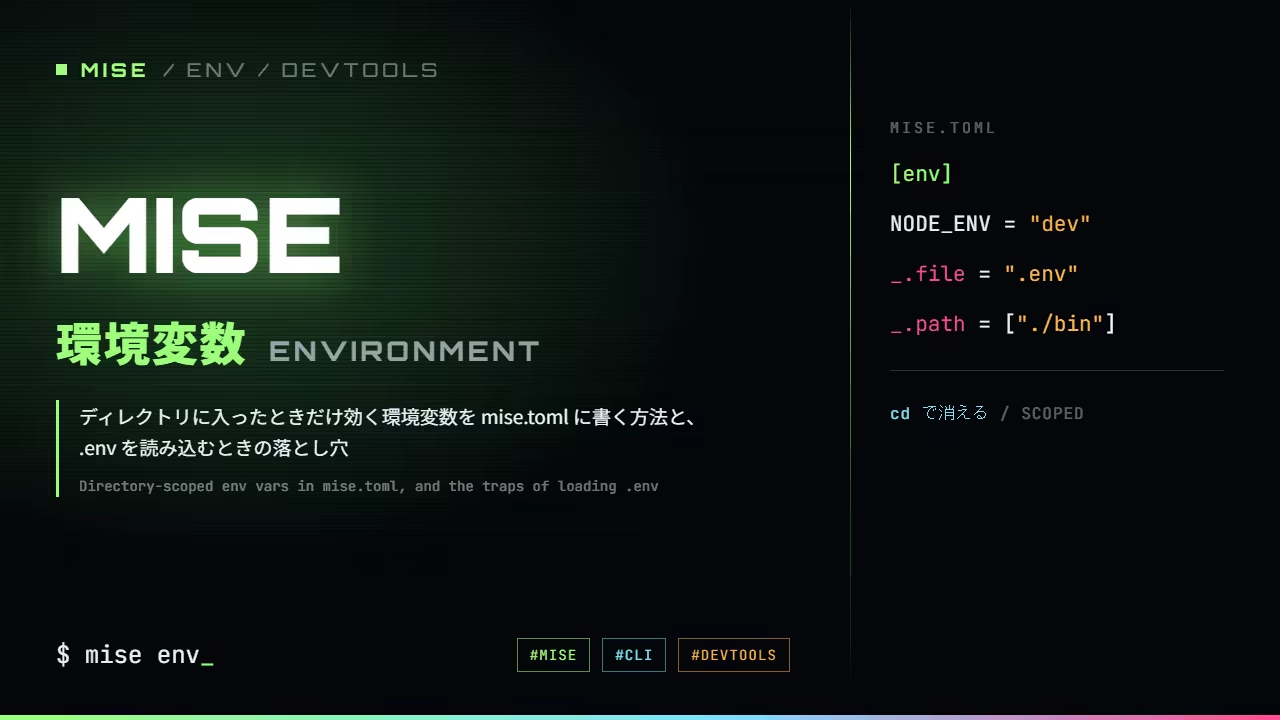
Managing Environment Variables with mise
Writing environment variables that only apply inside a directory into mise.toml, and the traps in loading .env
September 11, 20267 MIN0 VIEWS